


By Kenneth Millar, Founder and Principal Managing Partner, SREI Group · Last reviewed: October 2026
On this page
- What an UPREIT is
- How a DST leads to an UPREIT
- Exit options DST Sponsors offer
- An illustrative example
- What OP units are
- What to weigh before an UPREIT
- How to scrutinize the REIT behind an UPREIT exit
- Frequently asked questions
What Is an UPREIT?
An UPREIT (Umbrella Partnership Real Estate Investment Trust), also known as a 721 exchange after Section 721 of the Internal Revenue Code, lets a property owner contribute real estate to a REIT’s operating partnership in exchange for operating partnership units (OP units) instead of cash, generally without triggering capital gains tax at the time of the contribution.
For most investors today, an UPREIT is not a standalone transaction. It is one possible exit from a Delaware Statutory Trust (DST): an investor first completes a 1031 exchange into a DST sponsored by or affiliated with a REIT, and the DST property may later be contributed to the REIT’s operating partnership, with the DST investors receiving OP units. Learn more about how DST investments work.
How Does a DST Lead to an UPREIT?
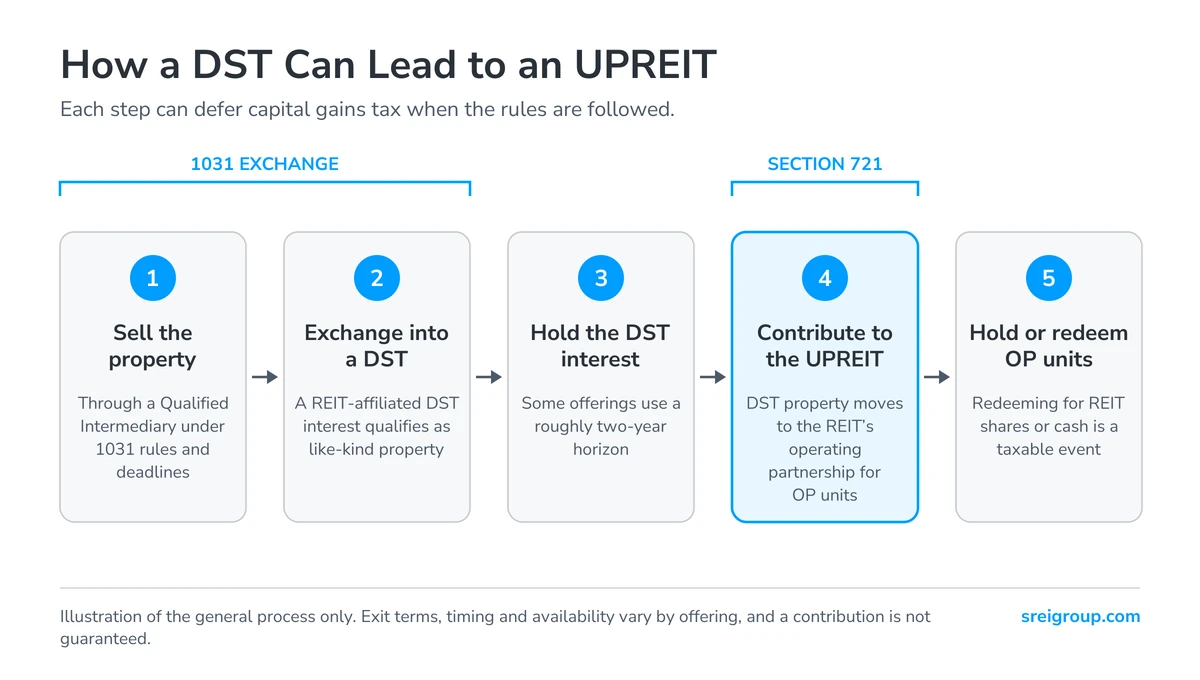
The path from a DST to an UPREIT moves an investor from a single property toward a diversified REIT portfolio in stages, deferring capital gains tax at each step when the rules are followed.
- Sell the relinquished property through a Qualified Intermediary, following standard 1031 exchange rules and deadlines.
- Exchange into a REIT-affiliated DST. The DST interest qualifies as like-kind real property under IRC Section 1031. DST offerings are generally available only to accredited investors.
- Hold the DST interest. Some DSTs are structured with a much shorter, roughly two-year horizon specifically designed as a bridge into a subsequent UPREIT (Section 721) contribution, rather than a standalone long-term hold.
- Reach the exit. Depending on the offering, the DST property is contributed to the UPREIT and investors receive OP units, or investors choose among the exit options the sponsor offers.
- Hold or redeem OP units. OP units may later be redeemed for REIT shares or cash, subject to the REIT’s terms. A redemption is a taxable event.
What Exit Options Do DST Sponsors Offer?
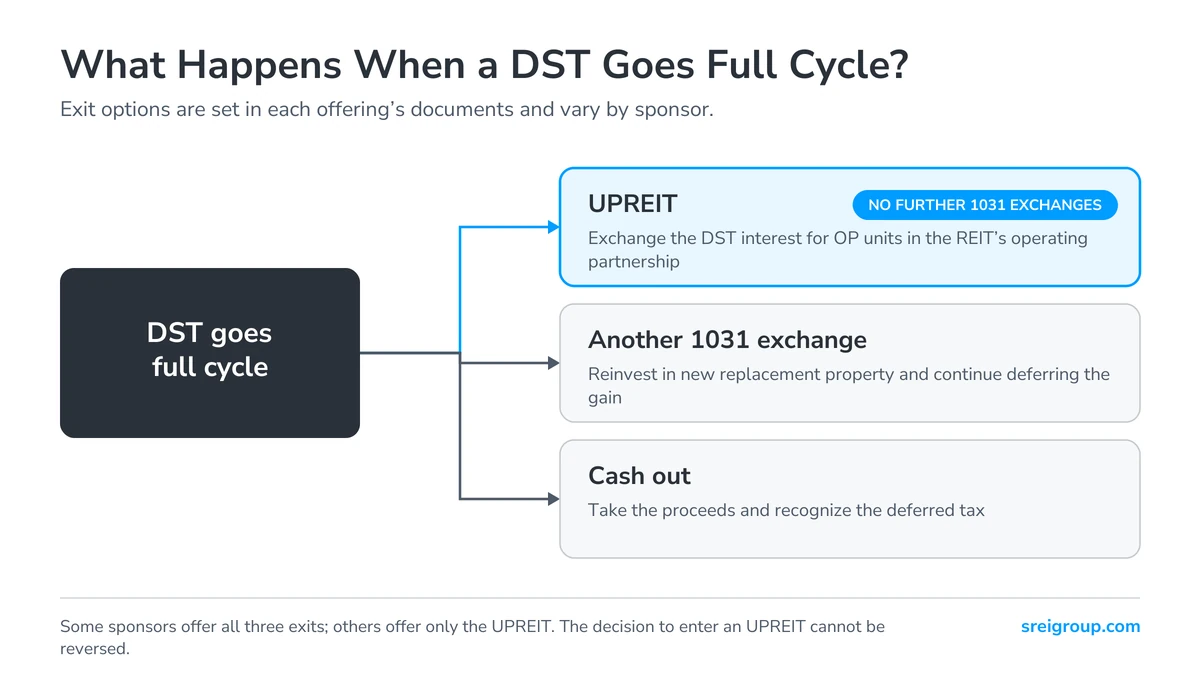
DST sponsors handle the exit differently, and the terms are set in each offering’s documents. Some sponsors offer investors a choice of three exits when the DST goes full cycle:
- UPREIT: contribute the DST interest to the REIT’s operating partnership for OP units.
- Another 1031 exchange: reinvest the proceeds in new replacement property and continue deferring the gain.
- Cash out: take the proceeds and recognize the deferred tax.
Other sponsors offer only the UPREIT option. Because the choices vary by sponsor, and because the decision to enter an UPREIT cannot be reversed, understanding an offering’s exit terms before investing matters. A knowledgeable professional can help compare sponsors and sort through how each exit fits an investor’s goals, timeline and estate plans.
An Illustrative Example
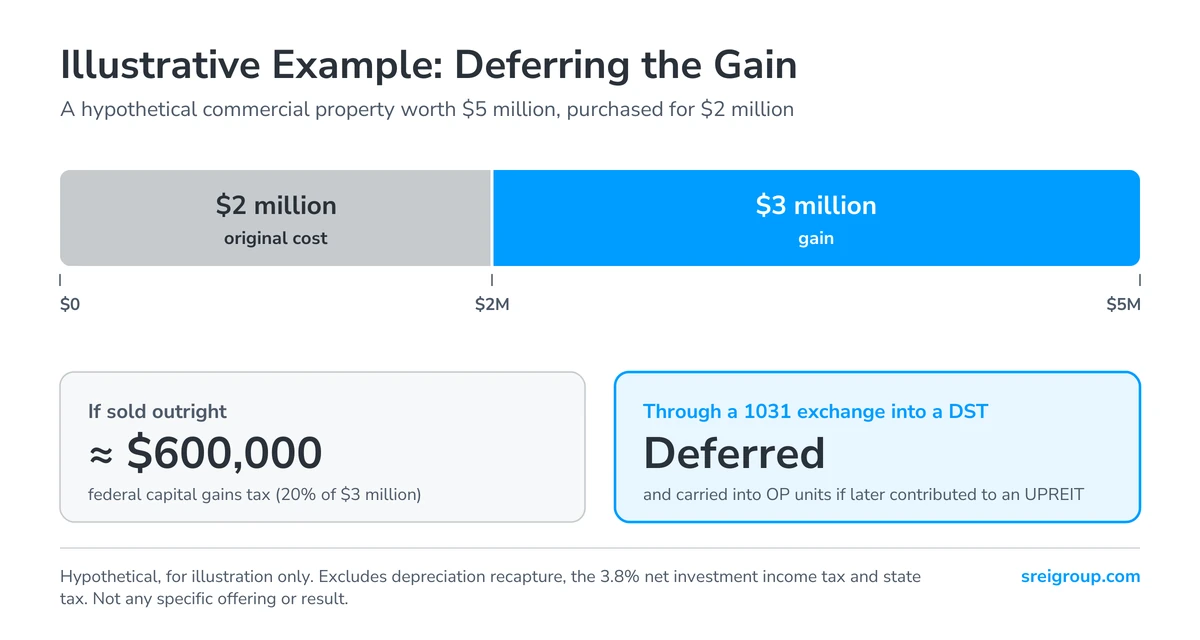
Suppose a commercial property worth $5 million was purchased for $2 million. Sold outright, the $3 million gain at a 20% federal long-term capital gains rate would mean about $600,000 in tax, before depreciation recapture, the 3.8% net investment income tax and any state tax.
If the owner instead completes a 1031 exchange into a REIT-affiliated DST, that tax is deferred. If the DST property is later contributed to the UPREIT, the investor receives OP units, and the deferred gain carries over into those units. This example is hypothetical and for illustration only; it does not represent any specific offering or result.
What Are OP Units?
OP units are ownership interests in the REIT’s operating partnership. They are generally designed to track the value of REIT shares and to receive distributions equal to the REIT’s dividends, giving the holder a share of the income and appreciation of the REIT’s full portfolio.
By contributing a single property, an investor gains exposure to the REIT’s broader portfolio of real estate across sectors and geographic regions. Diversification can help reduce concentration risk, though it does not eliminate the risks of real estate investing.
What Should Investors Weigh Before an UPREIT?
An UPREIT trades the flexibility of future 1031 exchanges for diversification and a simpler estate-planning path, and the decision has long-lasting consequences. Key points to understand before investing:
- No further 1031 exchanges. Once property is contributed for OP units, the units are not eligible for a 1031 exchange. The investor’s exchange path ends there, and the next redemption or sale is generally taxable, including the deferred gain and any depreciation recapture.
- Property sales inside the REIT. If the REIT later sells the property an investor contributed, the investor may be allocated taxable gain even without redeeming any OP units. Offering documents describe how the REIT handles these sales.
- Tax reporting. OP unit holders generally receive a Schedule K-1 and may have state filing obligations, and the taxable income allocated to them can differ from the cash distributions they receive.
- Exit terms vary by sponsor. Whether investors can choose among an UPREIT, another exchange or a cash out, or whether the UPREIT is the only exit, depends on the offering, as does the timing.
- Liquidity is limited. Many REITs that use DST-to-UPREIT programs are not publicly traded, and redemptions of OP units or shares may be limited or suspended.
- Corporate events. If the REIT is sold, merged or taken private, OP units may be converted in a transaction that triggers the deferred gain, outside the investor’s control.
- Valuation matters. The value assigned to the property at contribution determines the number of OP units received.
- Estate planning. Under current law, heirs may receive a step-up in cost basis on OP units held at death, which can reduce or eliminate the deferred tax.
- Investment risks remain. REIT performance depends on management, operating costs, interest rates, real estate markets and tax law, and there is no guarantee of income, appreciation or return of principal.
As with any investment, investors should review the offering documents in full and consult their own tax and legal professionals before investing.
How Should Investors Scrutinize the REIT Behind an UPREIT Exit?
An investor who enters an UPREIT may hold OP units for many years, so the REIT deserves as much scrutiny as the DST itself, and often more. Questions worth answering before investing in a DST with an UPREIT exit:
- Who decides whether the property is contributed to the REIT: the investor, or the REIT under an option to acquire it?
- How much debt does the REIT carry, and how much of that debt has a floating interest rate?
- Are distributions covered by operating cash flow, or partly funded by borrowing or new offering proceeds?
- What are the redemption terms, including holding periods, limits, whether redemptions can be paid in shares, and any past suspensions?
- How is the REIT’s net asset value determined, and how will the DST property be valued at contribution?
- What fees apply at the REIT level?
- How diversified is the portfolio by property type and region?
The answers are found in the DST’s private placement memorandum and in the REIT’s prospectus and periodic reports. Comparing them across sponsors takes time and experience, and it is where a knowledgeable professional can help an investor decide whether a particular UPREIT exit, or any UPREIT exit, fits their goals.
Frequently Asked Questions
-
What is the difference between a 1031 exchange and an UPREIT?
A 1031 exchange swaps one investment property for like-kind real property, such as another building or a DST interest, and can be repeated over time. An UPREIT contributes property to a REIT’s operating partnership for OP units. OP units are not real property, so once an investor enters an UPREIT, no further 1031 exchanges are possible.
-
Can I do a 1031 exchange directly into a REIT?
No. REIT shares and OP units are not like-kind real property, so a 1031 exchange cannot go directly into them. That is why the DST path has two steps: a 1031 exchange into a DST, then a later contribution of the DST property to the REIT’s operating partnership.
-
What exit options do DST sponsors offer?
It depends on the sponsor. Some offerings give investors a choice of three exits: an UPREIT, another 1031 exchange, or a cash out. Others offer only the UPREIT option. The terms are set in each offering’s documents, so they are worth understanding before investing.
-
How long do I hold the DST before an UPREIT?
Some DSTs are structured with a much shorter, roughly two-year horizon specifically designed as a bridge into a subsequent UPREIT (Section 721) contribution. The actual timing depends on the offering, and a contribution is not guaranteed.
-
Is an UPREIT taxable?
The contribution of property for OP units is generally not taxable. The deferred gain carries over into the OP units, and tax, including any depreciation recapture, is generally due when the units are redeemed for REIT shares or cash, or sold.
-
Can I sell or redeem my OP units?
OP units can generally be redeemed for REIT shares or cash after any holding period the REIT requires. Many REITs used in DST-to-UPREIT programs are not publicly traded, and redemptions may be limited or suspended. A redemption is a taxable event.
-
What happens to OP units when I pass away?
Under current tax law, heirs may receive a step-up in cost basis on OP units held at death, which can reduce or eliminate the deferred capital gains tax. Estate rules are complex and can change, so investors should plan with their tax and legal professionals.
-
What are the main risks of an UPREIT?
The main risks are giving up future 1031 exchanges, possible tax from property sales inside the REIT, limited liquidity, the value assigned to the property, and the performance of the REIT itself. As with other alternative investments, there is no guarantee of income, appreciation, or return of principal, and an investor could lose all or a substantial portion of the amount invested.
-
Who might consider a DST with an UPREIT exit?
It may suit investors who want to step back from property management and future exchange decisions, reduce concentration in one property or market, or simplify how real estate passes to heirs. It may be less suitable for investors who want to keep using 1031 exchanges, keep control of a specific property, or may need access to their capital.
Talk Through Your Options
Tell us a little about your situation and Kenneth Millar will reach out to schedule a conversation about 1031 exchanges, DSTs, UPREITs, Qualified Opportunity Funds and other private market real estate.
Ready to consider your next investment purchase?
(Fill out our contact form, highlight your needs, and we’ll get back to you within 24 hours.)