

By Kenneth Millar, Founder and Principal Managing Partner, SREI Group · Last reviewed: November 2026
A 1031 exchange lets you sell investment or business real estate and reinvest the proceeds in like-kind real property while deferring capital gains tax. The gain is deferred, not eliminated, and the exchange must follow strict IRS rules and deadlines from the day your sale closes.
This page walks through how an exchange works, what qualifies, the 45-day and 180-day deadlines, the role of the Qualified Intermediary (QI), and the replacement options investors use most, including Delaware Statutory Trusts (DSTs). If you are planning a sale now, start with our 1031 Exchange Checklist and 1031 Exchange Deadline Calculator.
On this page
- How a 1031 exchange works
- What a 1031 exchange can defer: an illustrative example
- What property qualifies
- The 45-day and 180-day deadlines
- What a Qualified Intermediary does
- How to defer all of the gain
- Common 1031 exchange mistakes
- Types of 1031 exchanges
- Replacement property options
- What to weigh, and what to have ready
- Frequently asked questions
How Does a 1031 Exchange Work?
Most exchanges today are delayed exchanges: you sell first, and buy the replacement property within the deadlines. Section 1031 of the Internal Revenue Code allows the gain on the sale to be deferred when the steps below are followed.
- Engage a Qualified Intermediary before the sale closes. The exchange paperwork needs to be in place at closing, and the sale proceeds generally must be held by the QI rather than by you.
- Sell the relinquished property. The day after closing is Day 1 of both the 45-day identification period and the 180-day exchange period.
- Identify replacement property in writing within 45 days. The identification is signed by you and delivered to your QI.
- Acquire the replacement property within 180 days. The QI uses the held proceeds to complete the purchase, and you take title as the same taxpayer that sold.
- Report the exchange. The exchange is reported to the IRS on Form 8824 with your tax return for the year of the sale. Your tax advisor prepares this filing.
What Can a 1031 Exchange Defer? An Illustrative Example
Suppose a commercial property worth $5 million was purchased for $2 million. Sold outright, the $3 million gain at a 20% federal long-term capital gains rate would mean about $600,000 in tax, before depreciation recapture, the 3.8% net investment income tax and any state tax.
| Sell outright | Complete a 1031 exchange | |
|---|---|---|
| Sale price | $5,000,000 | $5,000,000 |
| Original purchase price | $2,000,000 | $2,000,000 |
| Gain on the sale | $3,000,000 | $3,000,000 |
| Federal capital gains tax at 20% | About $600,000, due for the year of the sale | Deferred |
| Proceeds that can be reinvested | About $4,400,000 | $5,000,000 |
Figures are before closing costs and debt payoff. Depreciation recapture, the net investment income tax and state tax would add to the tax due on an outright sale. This example is hypothetical and for illustration only; it does not represent any specific property, offering or result. Your CPA can estimate the tax on your own sale.
What Property Qualifies for a 1031 Exchange?
Both the property you sell and the property you buy must be real estate held for investment or for use in a business. Since 2018, Section 1031 applies only to real property, not to equipment, vehicles or other personal property.
“Like-kind” is broad for real estate. Most U.S. investment real estate is like-kind to other U.S. investment real estate, so a rental home can be exchanged for an apartment building, raw land, a retail center or an interest in a Delaware Statutory Trust (DST). A few exceptions matter:
- Primary residences and second homes held for personal use do not qualify.
- U.S. property is not like-kind to property outside the United States.
- Property bought to resell quickly, such as a fix-and-flip, generally does not qualify, because it is held for sale rather than for investment.
- REIT shares and operating partnership (OP) units are not real property, so an exchange cannot go directly into them. Learn how some investors reach a REIT in two steps on our UPREIT / 721 Exchange page.
What Are the 45-Day and 180-Day Deadlines?
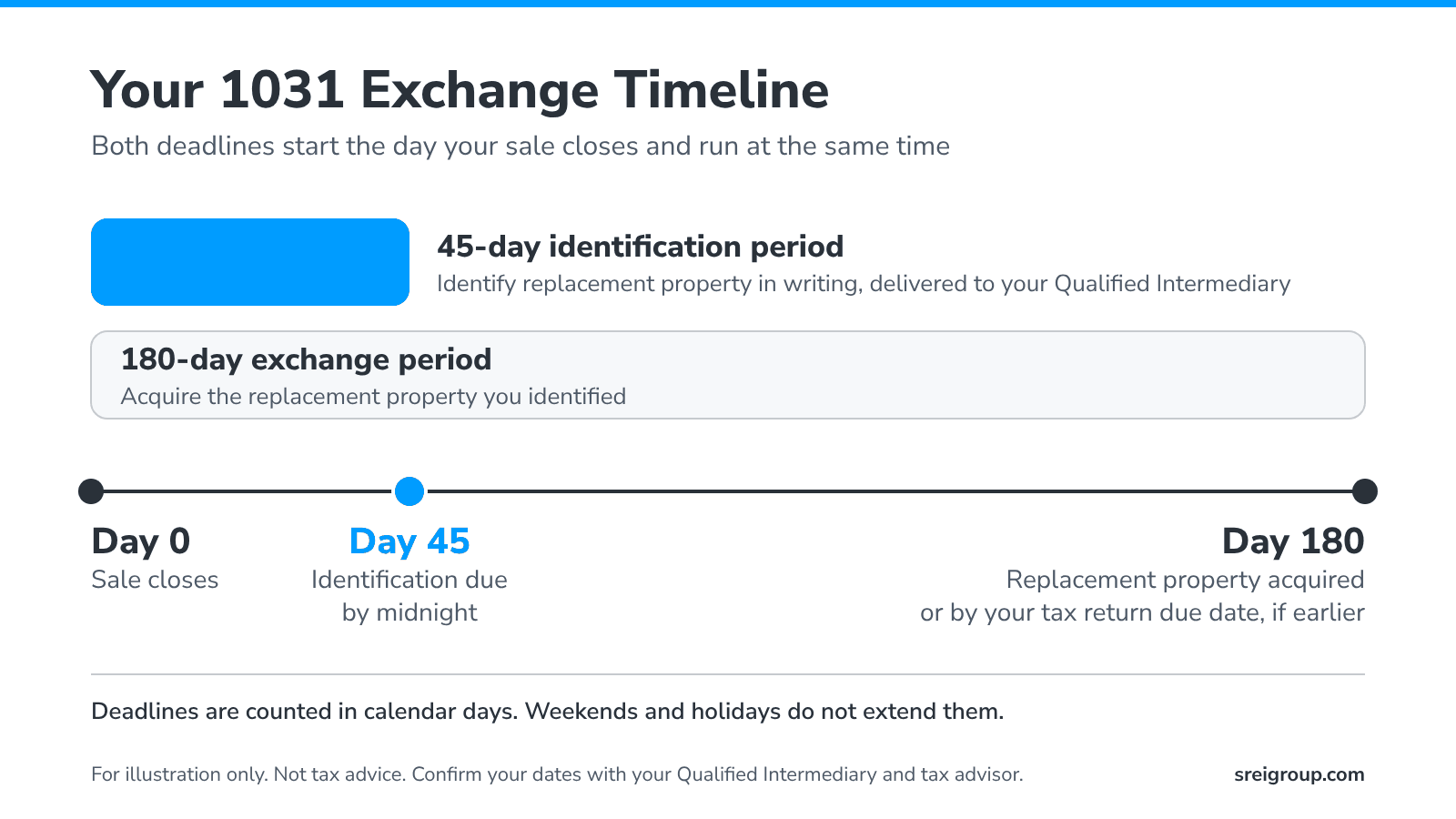
A 1031 exchange runs on two federal deadlines that start when your sale closes: 45 days to identify replacement property and 180 days to acquire it. The two periods run at the same time, so the 45 days are part of the 180, not added to them.
- 45-day identification deadline. You have until midnight on the 45th day after your sale closes to identify possible replacement properties, in writing, signed by you, and delivered to your Qualified Intermediary. Most investors identify up to three properties of any value; the 200% and 95% rules allow more.
- 180-day exchange deadline. You must receive your replacement property by the earlier of the 180th day after your sale closes or the due date of your federal tax return for the year of the sale, including extensions.
Both periods are counted in calendar days, and a deadline that lands on a weekend or holiday stays where it is. If you do not identify property within 45 days, or do not acquire identified property within the exchange period, the exchange generally fails and the gain becomes taxable. Find your 45-day and 180-day deadlines with our calculator.
Selling in the next six months? The 45 days go quickly. Get our free 1031 Exchange Checklist to organize your sale details, share with your CPA, and bring to your first conversation. Get the checklist
What Does a Qualified Intermediary Do?
A Qualified Intermediary (QI), sometimes called an accommodator, holds your sale proceeds and documents the exchange so the money never passes through your hands. Arrange the intermediary before your sale closes, because the paperwork needs to be in place at closing.
At SREI Group, we can work with the client’s QI to effect the purchase; however, we don’t endorse any. Please know that the Qualified Intermediary industry is not regulated; there have been failures where the investor’s money is lost. The list below is a few of the largest firms for your consideration. It is recommended you do your own research. Each of these companies has a very extensive collection of website articles and checklists.
- Investment Property Exchange Services, Inc., IPX1031 is backed by Fidelity National Financial. www.ipx1031.com
- Exeter 1031 Exchange Services, LLC, headquartered in San Diego, California. www.exeterco.com
- Asset Preservation, Inc., a subsidiary of Stewart Title Company. www.apiexchange.com
- Accruit, an Inspira Financial Solution. www.accruit.com
You will also find a wealth of information about the Qualified Intermediary industry at the Federation of Exchange Accommodators. www.1031.org
How Do I Defer All of the Gain?
To defer all of the gain, the replacement property generally needs equal or greater value and debt, or added cash. Anything you receive that is not like-kind real property is called “boot,” and boot is generally taxable.
- Cash boot. Cash you keep from the sale is generally taxable.
- Debt (mortgage) boot. Debt paid off at closing that is not replaced with new debt or added cash can also be taxable.
- Same taxpayer. The same taxpayer that sells must generally buy the replacement property, so how the property is titled (individual, joint, trust, LLC or partnership) matters before you list it.
Your CPA can estimate the capital gains and depreciation recapture an exchange may defer, and how much of a partial exchange would be taxable.
What is a partial 1031 exchange? If you reinvest only part of the proceeds, or take on less debt than you paid off, the exchange can still go forward. The boot is generally taxable, while the gain tied to the property you reinvest in can remain deferred. Some investors choose a partial exchange on purpose to take some cash out of the sale.
What Are the Most Common 1031 Exchange Mistakes?
Most failed or partly taxable exchanges come from a handful of avoidable errors, and most of them happen before or right after closing.
| Mistake | What can happen | How to avoid it |
|---|---|---|
| Taking control of the sale proceeds | The exchange generally fails once the money passes through your hands | Engage a Qualified Intermediary before closing and have proceeds go directly to the QI |
| Waiting until after closing to plan | Too little time to find, review and close on replacement property | Start planning while the property is being listed or marketed |
| Missing the 45-day identification deadline | The exchange generally fails and the gain becomes taxable | Mark the date on Day 1 and identify backup properties |
| Not replacing debt paid off at closing | Debt relief that is not replaced can be taxable as boot | Replace it with new debt or added cash, or plan for the tax |
| Buying in a different name than you sold in | The exchange may not qualify | Confirm with your advisors that the same taxpayer sells and buys |
| Exchanging with a related party | Deferral can be lost if either side sells within two years, and buying from a related party is restricted | Review any family or affiliated-company transaction with your tax advisor first |
| Exchanging property held for personal use | A primary residence or personal vacation home does not qualify | Confirm both properties are held for investment or business use |
| Identifying only one property | If that purchase falls through, the exchange can fail | Use the three-property rule to name backups, such as a DST interest |
What Types of 1031 Exchanges Are There?
There are three main types, and the delayed exchange is by far the most common.
| Type | Order of events | Often used when | Complexity and cost |
|---|---|---|---|
| Delayed exchange | Sell first, then acquire the replacement property within the 45-day and 180-day deadlines | The relinquished property is under contract and replacement property is still being chosen | Lowest; the most common structure |
| Reverse exchange | Acquire the replacement property first; an exchange accommodator holds title to one property until the exchange is completed | The right replacement property must be secured before the current property sells | Higher; added accommodator fees and financing considerations |
| Improvement exchange | Exchange proceeds pay for improvements to the replacement property, which must be completed and received within the 180 days to count | The replacement property needs construction or renovation to reach equal or greater value | Highest; tight construction timing and added accommodator involvement |
What Can I Exchange Into?
The right replacement property depends on whether you want to keep managing real estate, how much income and diversification matter to you, and how you want the property to pass to your heirs. Investors most often choose among three paths.
Another property you own directly. You keep full control, and you keep the responsibility for tenants, repairs, financing and the eventual sale. Finding, negotiating and closing on the right property inside 45 and 180 days can be the hardest part of an exchange.
An interest in a Delaware Statutory Trust (DST). A DST is one replacement option for investors who want to complete a 1031 exchange without taking on property management. A DST interest qualifies as “like-kind” real property under IRC Section 1031, so proceeds from the sale of an investment property can be reinvested into a DST without immediately triggering capital gains tax. DST offerings are already structured, which can make them easier to close within the exchange period, and some investors identify one as a backup if a direct purchase falls through. DST interests are illiquid, and the sponsor, not the individual investor, controls management and the timing of the sale. DST offerings are available only to accredited investors. Learn more about DST investments.
A DST with an UPREIT (721 exchange) exit. Some DSTs are sponsored by or affiliated with a REIT. When the DST goes full cycle, the property may be contributed to the REIT’s operating partnership, and investors receive operating partnership (OP) units instead of cash. This can move an investor from a single property toward a diversified REIT portfolio, but once an investor enters an UPREIT, no further 1031 exchanges are possible, and a later redemption of OP units is a taxable event. Learn how a DST can lead to an UPREIT.
How do direct ownership and a DST interest compare as replacement property?
| Property you own directly | Interest in a DST | |
|---|---|---|
| Day-to-day management | You or your property manager | The sponsor and its property managers |
| Decisions and timing of the sale | Yours | Made by the sponsor for all investors |
| Fit with the 45-day and 180-day deadlines | You find, negotiate and close on your own | Offerings are already structured, which can make them easier to close within the exchange period |
| Spreading proceeds across properties | Usually one or a few properties | Proceeds can be divided among more than one DST, subject to each offering’s minimum |
| Financing | You arrange and personally manage the loan | Any financing is held by the trust and is non-recourse against individual investors |
| Liquidity | You decide when to list and sell | Illiquid; the investment is generally held until the sponsor sells the property |
| Who can invest | Any buyer | Accredited investors only, under each offering’s suitability requirements |
| After the sale | Another 1031 exchange is possible | Exit options depend on the offering and may include another 1031 exchange, an UPREIT or cash |
Both carry the risks of real estate ownership, and neither guarantees income, appreciation or return of principal.
Sponsors handle exits differently, and the choice you make at the start of an exchange can shape your options for years. A knowledgeable professional can help compare offerings and how each path fits your goals, timeline and estate plans.
What Should I Weigh Before a 1031 Exchange?
A 1031 exchange can keep more of your equity working, but it is not the right move for every sale. Points to discuss with your tax advisor before you list the property:
- The tax is deferred, not eliminated. The deferred gain, including depreciation recapture, carries into the replacement property and is generally taxed when that property is later sold outside an exchange.
- The deadlines are firm. A failed exchange makes the gain taxable for the year of the sale, so a backup plan for replacement property matters.
- Replacement property carries its own risks. Real estate, whether owned directly or through a DST, can lose value, and income is not guaranteed. DST interests are illiquid, long-term holdings, and an investor could lose all or a substantial portion of the amount invested.
- Estate planning. Under current law, heirs may receive a step-up in cost basis on property held at death, which can reduce or eliminate the deferred tax. Your estate attorney can explain how this applies to you.
What Should I Have Ready Before a 1031 Exchange?
The smoothest 1031 exchanges start before the property sells. Once the sale closes, there is little time to gather facts, so have these details ready:
- Your expected closing date, sale price and estimated net proceeds
- The mortgage debt that will be paid off at closing
- How the property is titled, and whether all owners agree on the plan
- A Qualified Intermediary engaged before closing
- Whether you meet the accredited investor standard required for most DST offerings
See the full 1031 Exchange Checklist, or request our free 1031 Exchange Guide to share with your CPA.
Frequently Asked Questions
-
What is a 1031 exchange in simple terms?
A 1031 exchange lets you sell investment or business real estate and buy other like-kind real estate without paying capital gains tax on the sale right away. The gain is deferred, not eliminated, and the exchange must follow IRS rules and deadlines.
-
Can I use a 1031 exchange on my primary residence?
No. A 1031 exchange applies only to real property held for investment or for use in a business. A home you live in, or a vacation home held for personal use, does not qualify.
-
When does the 45-day clock start in a 1031 exchange?
The clock starts when your relinquished property transfers, which is usually the closing date of your sale. The day after closing counts as Day 1, and the identification period ends at midnight on Day 45.
-
What happens if I miss the 45-day or 180-day deadline?
The exchange generally fails, and the gain becomes taxable for the year of the sale. The deadlines are not extended except in limited cases, such as federally declared disasters. The 180-day period can also end sooner if your tax return for the year of the sale is due first, unless you file an extension.
-
Do I need a Qualified Intermediary for a 1031 exchange?
In a delayed exchange, the sale proceeds generally must be held by a Qualified Intermediary rather than by you. Arrange the intermediary before your sale closes, because the paperwork needs to be in place at closing.
-
Can I keep some of the cash from my sale?
Yes, but cash you keep is generally taxable. Debt paid off at closing that is not replaced with new debt or added cash can also be taxable.
-
Can a DST be my replacement property in a 1031 exchange?
Yes. An interest in a Delaware Statutory Trust is generally treated as an interest in real estate for a 1031 exchange, so many investors use one as primary or backup replacement property. DST investments are available only to accredited investors and carry risks, including illiquidity and the potential loss of principal.
-
Can I do a 1031 exchange directly into a REIT?
No. REIT shares and OP units are not like-kind real property, so a 1031 exchange cannot go directly into them. That is why the DST path has two steps: a 1031 exchange into a DST, then a later contribution of the DST property to the REIT’s operating partnership.
-
Can I do more than one 1031 exchange over time?
Yes. There is no limit on the number of exchanges, so some investors continue deferring gain from one property to the next for many years. Entering an UPREIT ends that path, because OP units cannot be exchanged under Section 1031.
-
When should I start planning a 1031 exchange?
Start before the sale closes. A Qualified Intermediary generally needs to be in place before closing, and the 45-day and 180-day deadlines begin when the sale closes. Starting early leaves more time to review replacement options.
Talk Through Your Options
Tell us a little about your situation and Kenneth Millar will reach out to schedule a conversation about 1031 exchanges, DSTs, Qualified Opportunity Funds and other private market real estate.
Ready To Get Started?
(Fill out our contact form, highlight your needs, and we’ll get back to you within 24 hours.)
This page is for general educational purposes only and is not tax or legal advice. Neither SREI Group, Saxony Securities, nor Saxony Capital Management provides tax advice. Consult your tax and legal advisors about your specific situation.