
By Kenneth Millar, Founder and Principal Managing Partner, SREI Group · November 2026
At a glance: Oil, gas and mineral investing means owning rights to oil, natural gas, gold, silver or other minerals in the ground, or a share of the revenue when they are produced. Investors consider these alternative investments for potential income, diversification from stocks and real estate, and tax treatment that includes depletion allowances. Qualifying mineral interests count as real property, so real estate investors can move into them through a 1031 exchange. They are also speculative and illiquid, with income tied to commodity prices and production, and most private offerings are limited to accredited investors.
Oil, natural gas, gold, silver and other minerals can be owned, leased and sold separately from the land above them, which makes mineral interests a distinct class of alternative investments. For real estate investors, one feature stands out: qualifying mineral interests count as real property, so they can serve as replacement property in a 1031 exchange. This page explains how the sector works, how investors move between real estate and minerals, where Qualified Opportunity Funds fit, the main offering types, and the risks to weigh.
On this page
- What oil, gas and mineral investing is
- Using a 1031 exchange to move into mineral interests
- How 1031 exchanges, DSTs and QOFs apply to this sector
- Types of mineral interests
- Types of private offerings
- Why investors consider these interests
- How they are taxed
- What to look for before investing
- Who can invest
- Risks
- Frequently asked questions
What Is Oil, Gas and Mineral Investing?
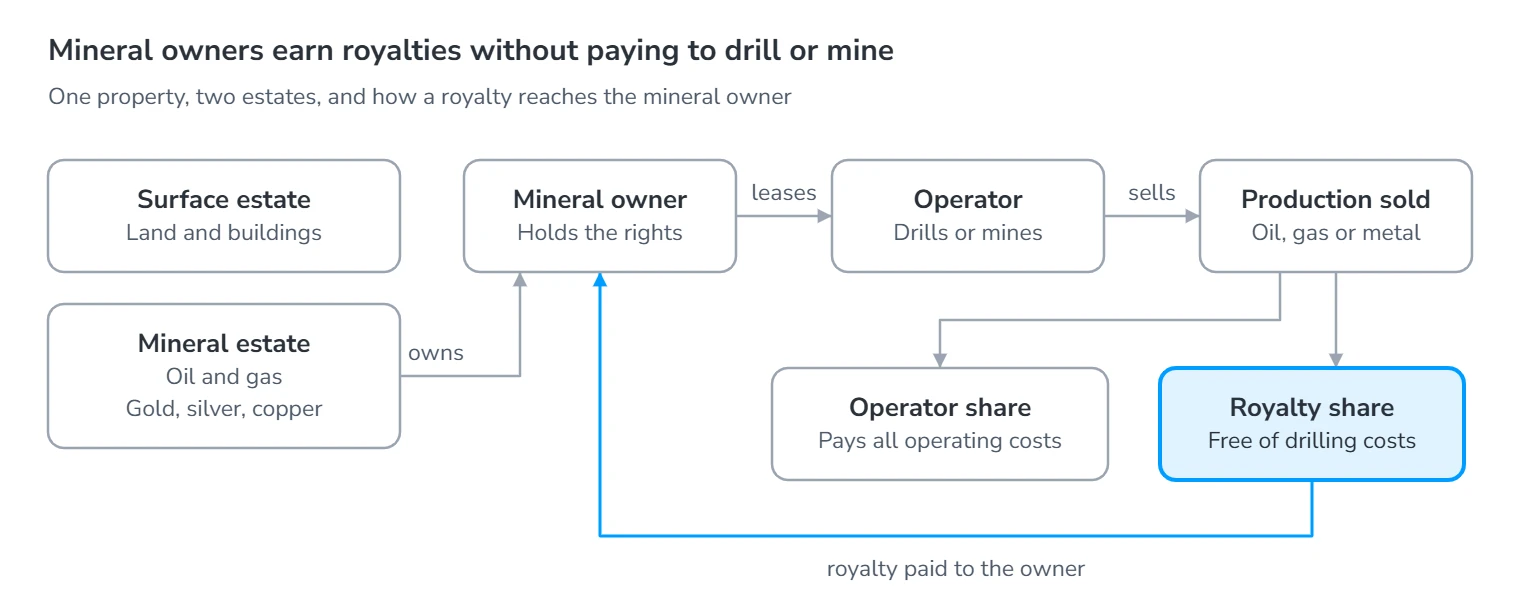
Oil, gas and mineral investing means owning an interest in minerals beneath the ground, or in the revenue produced when they are extracted and sold. In the U.S., the mineral estate can be separated from the surface, so one party may own the land while another owns what lies below. The sector covers two groups:
- Energy minerals: oil and natural gas, produced from wells.
- Hard-rock minerals: precious metals such as gold, silver and platinum, and base metals such as copper, produced from mines.
Mineral owners usually lease their rights to an operator, which drills or mines the property and pays the owner a lease bonus and an ongoing royalty from production. A mineral interest in a gold deposit is different from owning gold: the interest can pay royalties from production, while physical metal pays no income and is taxed as a collectible.
Can You Use a 1031 Exchange to Move From Real Estate Into Mineral Interests?
Yes. Under Treasury Regulation §1.1031(a)-3, real property includes land and its unsevered natural products, so qualifying oil, gas and hard-rock mineral interests are like-kind to rental property, land and other investment real estate. An investor can exchange out of real estate into minerals, or from minerals back into real estate, under the same rules that apply to any 1031 exchange.
Hypothetical example. An investor sells a rental property for $1,200,000 and wants potential income without tenants or repairs:
- Before closing, the investor engages a Qualified Intermediary (QI), who holds the sale proceeds.
- Within 45 days of the sale, the investor identifies replacement property in writing, such as a mineral or royalty DST and a portfolio of direct royalty interests.
- Within 180 days of the sale, the QI uses the proceeds to acquire the identified interests.
- If all net proceeds are reinvested in property of equal or greater value, the capital gain is deferred.
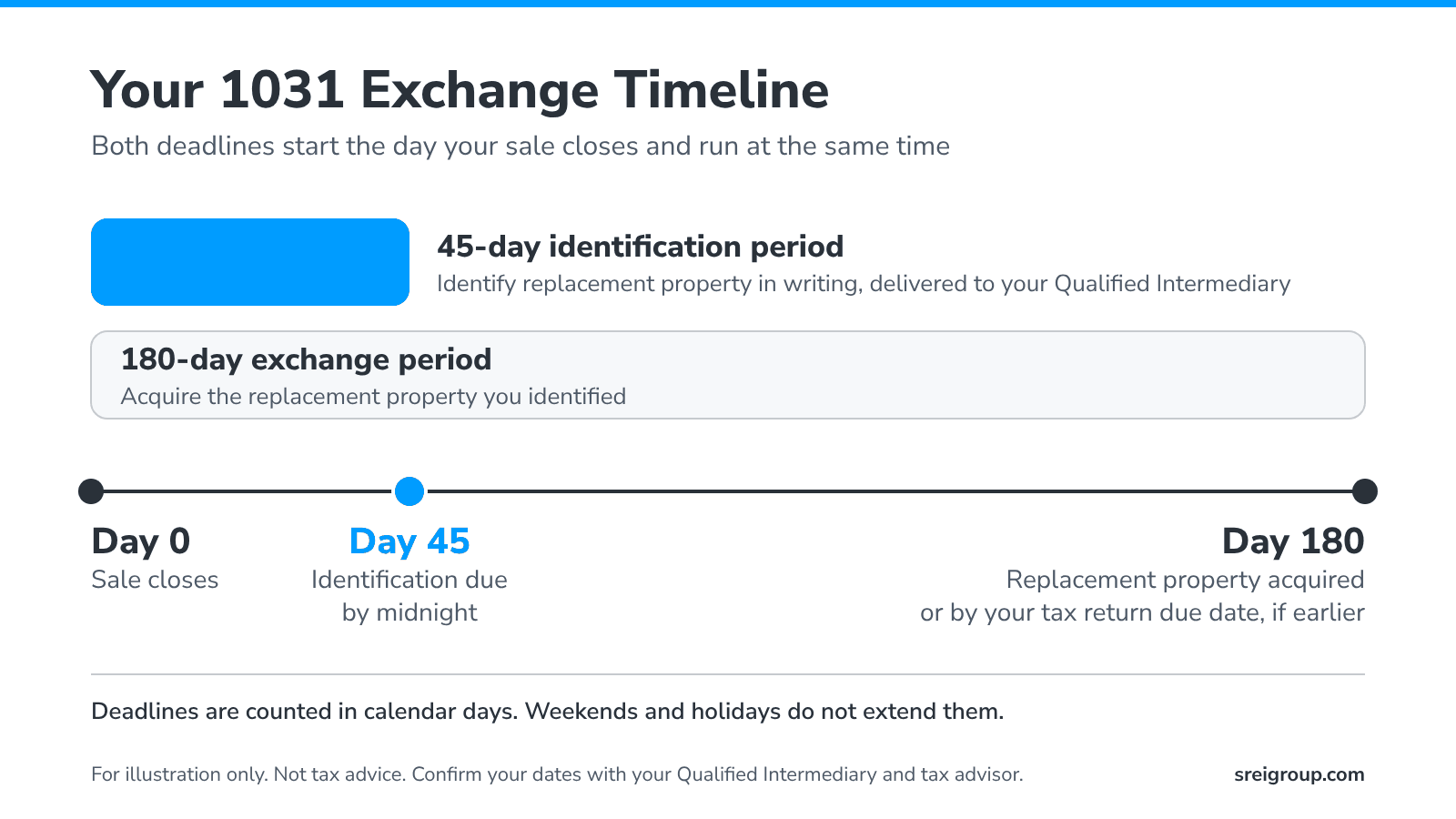
This example is for illustration only and does not represent any specific offering or result. Use our 1031 Exchange Deadline Calculator to find your 45-day and 180-day dates.
- Commonly qualify: perpetual mineral and royalty interests; working interests and overriding royalties that last until the minerals are exhausted; patented mining claims; and DSTs structured to hold mineral interests.
- May qualify: unpatented mining claims, depending on state law.
- Generally do not qualify: production payments and other term-limited interests, partnership or LLC units, and physical metals.
Because the IRS looks to state law, the location of the minerals can affect eligibility. Learn more on our 1031 Exchange and Delaware Statutory Trust pages.
How Do 1031 Exchanges, DSTs and Qualified Opportunity Funds Apply to This Sector?
The right path usually depends on what you are selling and how you want to own the interest.
| If you are selling | Path into the sector | How it works |
|---|---|---|
| Investment real estate | 1031 exchange into direct mineral or royalty interests | You hold title to qualifying interests as replacement property; the 45-day and 180-day deadlines apply |
| Investment real estate | 1031 exchange into a mineral or royalty DST | A sponsor-managed trust holds the interests; you own a passive beneficial interest |
| A business, stock or other appreciated asset | Qualified Opportunity Fund (QOF) | Only the gain is reinvested, generally within 180 days, in a fund that invests in Opportunity Zone businesses |
A Qualified Opportunity Fund (QOF) accepts capital gains from almost any asset, and only the gain itself needs to be reinvested, generally within 180 days. Under the permanent program, which applies to QOF investments made on or after January 1, 2027, each investment gets its own five-year deferral period, and appreciation on the QOF investment itself can become tax-free if it is held for at least 10 years.
In this sector, QOFs generally invest through operating businesses located in Opportunity Zones, such as companies in energy, mining or precious metals services, rather than through passive royalty interests. Many of these businesses are in rural areas, where a Qualified Rural Opportunity Fund may offer a larger basis increase. See Qualified Opportunity Zone & QOF Investments.
What Types of Mineral Interests Can Investors Own?
The main interest types differ in what you own and whether you pay drilling, mining or operating costs.
| Interest type | What you own | Costs and involvement |
|---|---|---|
| Mineral interest | The minerals in place and the right to lease them | No drilling or mining costs; passive once leased |
| Royalty interest | A share of production revenue, without the right to lease | No drilling or mining costs; passive |
| Overriding royalty interest (ORRI) | A share of production revenue carved out of a lease, lasting as long as the lease | No drilling or mining costs; passive |
| Working interest | The right to drill or mine under a lease | Pays a share of all costs; highest risk and highest potential reward |
| Net smelter return (NSR) royalty | A percentage of a mine’s metal sales, less certain processing and transport costs | No mining costs; passive |
| Patented mining claim | Full title to the land and minerals, granted by the federal government | Costs only if the owner develops it |
Unpatented mining claims on federal land give the right to extract minerals but not title to the land, and they must be maintained each year to stay valid.
What Types of Private Oil, Gas and Mineral Offerings Are Available?
Private offerings are generally sold as Regulation D private placements to accredited investors. The structure determines what you own and whether it can be used in a 1031 exchange.
| Structure | What you hold | 1031 use | Key traits |
|---|---|---|---|
| Mineral or royalty DST | A beneficial interest in a trust holding producing interests | Can qualify, depending on the interests held and state law | Fully passive; sponsor-managed |
| Direct fractional interests | Deeded title to an undivided share of mineral or royalty interests | May qualify | Passive; you hold title directly |
| Precious metals mineral and claim interests | Title to mineral rights, royalties or patented claims on metals deposits | May qualify if real property | Income depends on a mine producing |
| Mineral and royalty funds (LP or LLC) | Units in a fund that owns a portfolio of interests | Generally not eligible | Broader diversification; Schedule K-1 |
| Drilling, mining and working interest programs | Partnership units or direct working interests | Generally not used | Tax deductions; higher cost risk; possible capital calls |
| Operating company shares, including Qualified Opportunity Fund (QOF) corporations | Stock in a company that explores, mines, trades or stores metals or energy | Not eligible; may qualify for Opportunity Zone treatment | Results tied to the business; liquidity limited to any repurchase program |
Each offering is described in a Private Placement Memorandum (PPM), and offerings intended for 1031 use typically include a tax opinion. Public alternatives such as energy and mining stocks, royalty and streaming companies, precious metals funds and bullion do not qualify for 1031 exchanges.
Why Do Investors Consider Oil, Gas and Mineral Interests?
- Potential income. Royalty and working interests can pay distributions when wells or mines produce. Payments vary with production and prices and are not guaranteed.
- Diversification. Energy and metals prices respond to different forces than stocks, bonds and commercial real estate, and to different forces from each other.
- A tangible real asset. Mineral interests are physical resources, and precious metals have long been viewed as a store of value, though price behavior is not consistent.
- Tax treatment. Depletion and, for working interests, drilling and development deductions can offset part of the income or investment.
- 1031 flexibility. Qualifying interests let real estate investors exchange into minerals, or back into real estate later.
- No property management. Non-operating interests involve no tenants, repairs or leasing decisions.
How Are Oil, Gas and Mineral Investments Taxed?
- Depletion allowance. Owners of producing interests deduct the greater of cost or percentage depletion. Percentage depletion is generally 15% of gross income for oil and gas independent producers and royalty owners, and generally 15% for U.S. gold, silver and copper deposits, subject to limits.
- Drilling and development costs. Oil and gas working interest owners can generally deduct intangible drilling costs (IDCs) in the year incurred. Some mine exploration and development costs may also be deductible, subject to limits and recapture.
- Equipment. Well and mining equipment is depreciated. The Working Families Tax Cuts legislation, signed into law in July 2025, restored 100% bonus depreciation for qualifying property acquired after January 19, 2025, and left IDC expensing and percentage depletion in place.
- Passive activity exception. An oil and gas working interest held directly, or through an entity that does not limit the owner’s liability, is generally not passive, so related losses may offset other income.
- Physical metals. Bullion and funds holding physical metal are taxed as collectibles, at up to 28% on long-term gains, with no depletion allowance.
| Tax feature | Mineral or royalty interest | Working interest (held directly) | Physical metals |
|---|---|---|---|
| Depletion allowance | Yes, on production income | Yes, on production income | No |
| Intangible drilling cost deduction | No | Generally yes, in the year incurred | No |
| Losses can offset salary or business income | Generally no | Generally yes | No |
| 1031 replacement property | Yes, if real property under state law | Yes, if it lasts until the minerals are exhausted | No |
| Long-term gain on sale | Capital gains rates; prior depletion may be recaptured | Capital gains rates; prior deductions may be recaptured as ordinary income | Up to 28% as a collectible |
Tax outcomes depend on your situation and on how an offering is structured, so review any mineral investment with your CPA or tax advisor.
What Should You Look For Before Investing in a Mineral Offering?
Results in this sector depend on geology, operators and commodity prices, so the offering documents deserve close review. Questions to ask about any oil, gas or mineral offering:
- Who operates the wells or mines, and what is their track record?
- Is the property producing now, or does income depend on future drilling or mine development?
- Has an independent petroleum engineer or geologist prepared a reserve or deposit report, and how recent is it?
- Has a title opinion confirmed ownership of the interests being sold?
- What fees does the sponsor charge, and when are they paid?
- How diversified is the portfolio across wells, mines, operators and regions?
- For 1031 use, does the offering include a tax opinion that the interests qualify as real property?
- How and when are distributions paid, and what are the options for exiting the investment?
- If the offering is a Qualified Opportunity Fund, how does it meet the Opportunity Zone asset and business requirements, and what happens to the tax benefits if it does not?
Who Can Invest in Private Oil, Gas and Mineral Offerings?
Most private oil, gas and mineral offerings are open only to accredited investors. Individuals generally qualify with income over $200,000 ($300,000 with a spouse or spousal equivalent) in each of the last two years, net worth over $1 million excluding a primary residence, or an active Series 7, 65 or 82 license. Rule 506(c) offerings may be advertised but require verification of accredited status, and minimum investments vary by offering. See What Is an Accredited Investor for details.
What Are the Risks of Oil, Gas and Mineral Investing?
Oil, gas and mineral interests are speculative, illiquid investments, and you could lose some or all of your principal. Key risks include:
- Commodity prices. Income and value move with oil, gas and metals prices, which can change sharply.
- Depletion. Wells and mines produce less over time unless new production is developed.
- Operators. Results depend on operators the investor does not control.
- Reserve and deposit estimates. Recoverable reserves, ore grade and future production may prove lower than expected.
- Mine development and permitting. Many hard-rock deposits are not yet producing and may take years to reach production, or never do.
- Title, lease and claim issues. Defects or missed claim maintenance can reduce income or cause an interest to be lost.
- Illiquidity. There is usually no public market, and holding periods can be long. Some offerings provide limited periodic share repurchases, which can be capped or suspended.
- Regulation, costs and tax law. Policy changes, cost overruns, capital calls for working interest owners, and changes in tax law can all affect results.
How Can SREI Group Help?
SREI Group works with investors who want to add oil, gas and mineral interests, including precious metals, to a broader mix of alternative investments. We compare them with real estate options such as Delaware Statutory Trusts (DSTs), Qualified Opportunity Funds (QOFs), UPREIT/721 exchanges and private market real estate, walk through the due-diligence questions above, and coordinate with your CPA and attorney on tax and 1031 considerations.
Book Your Intro Call to talk through your situation, or Get in Touch with a question.
Frequently Asked Questions
What is the difference between a mineral interest and a royalty interest?
A mineral interest is ownership of the minerals themselves, including the right to lease them and collect a lease bonus and royalties. A royalty interest is a share of production revenue only, without the right to lease. Neither pays drilling or operating costs.
Do oil, gas and mineral investments pay income?
They can. Royalty and working interests may pay periodic distributions when wells or mines produce and the oil, gas or metal is sold. Payments vary with production and commodity prices, decline as properties deplete, and are not guaranteed.
What tax benefits do oil, gas and mineral investments offer?
Owners of producing interests may claim a depletion allowance, generally 15% of gross income for oil and gas independent producers and royalty owners and for U.S. gold, silver and copper deposits, subject to limits. Oil and gas working interest owners can generally deduct intangible drilling costs in the year incurred. Review your situation with a tax advisor.
How is investing in precious metals mineral rights different from owning gold or silver?
A precious metals mineral interest is an ownership interest in metal still in the ground, which may pay royalties when a mine produces and may qualify for depletion and 1031 treatment. Physical gold or silver pays no income, is generally taxed as a collectible at up to 28% on long-term gains, and does not qualify for a 1031 exchange.
Can I use a 1031 exchange to buy mineral rights?
Yes, if the interest qualifies as real property. Perpetual mineral and royalty interests, working interests that last until the minerals are exhausted, patented mining claims, and DSTs structured to hold mineral interests can qualify. Production payments, partnership or LLC units and physical metals generally do not.
What is a mineral or royalty DST?
It is a Delaware Statutory Trust that owns producing mineral or royalty interests. Investors hold beneficial interests in the trust, which can be structured to qualify as replacement property in a 1031 exchange, and the sponsor manages the portfolio.
Can I invest in the energy or mining sector through a Qualified Opportunity Fund?
Yes, through a QOF that invests in an operating business located in an Opportunity Zone, such as a company in energy, mining or precious metals services. A QOF can accept capital gains from almost any asset, including stock or a business sale, which a 1031 exchange cannot. Passive mineral and royalty interests are more commonly held through a 1031 exchange or a mineral or royalty DST.
Do I need to be an accredited investor to invest in a mineral offering?
Most are limited to accredited investors, generally individuals with income over $200,000 ($300,000 joint) in each of the last two years or net worth over $1 million excluding a primary residence. Rule 506(c) offerings require verification of accredited status.
Talk Through Your Options
Tell us a little about your situation and Kenneth Millar will reach out to schedule a conversation about oil, gas and mineral interests, 1031 exchanges, DSTs and other alternative investments.
This material is for informational purposes only and is not an offer to sell or a solicitation of an offer to buy any security. Offerings are made only by Private Placement Memorandum to qualified investors. Oil, gas and mineral investments are speculative, illiquid and involve risk, including loss of principal. Distributions are not guaranteed. SREI Group does not provide tax or legal advice; consult your own tax and legal advisors.
Securities are offered through Saxony Securities, Inc., a member of FINRA/SIPC. Solomon Real Estate Investment Group (SREI Group) is independent of Saxony Securities, Inc. Investment advisory services are offered through Saxony Capital Management, LLC, an SEC Registered Investment Advisor.
Ready to consider your next investment purchase?
(Fill out our contact form, highlight your needs, and we’ll get back to you within 24 hours.)